How to Find a Better Campsite…and Truth
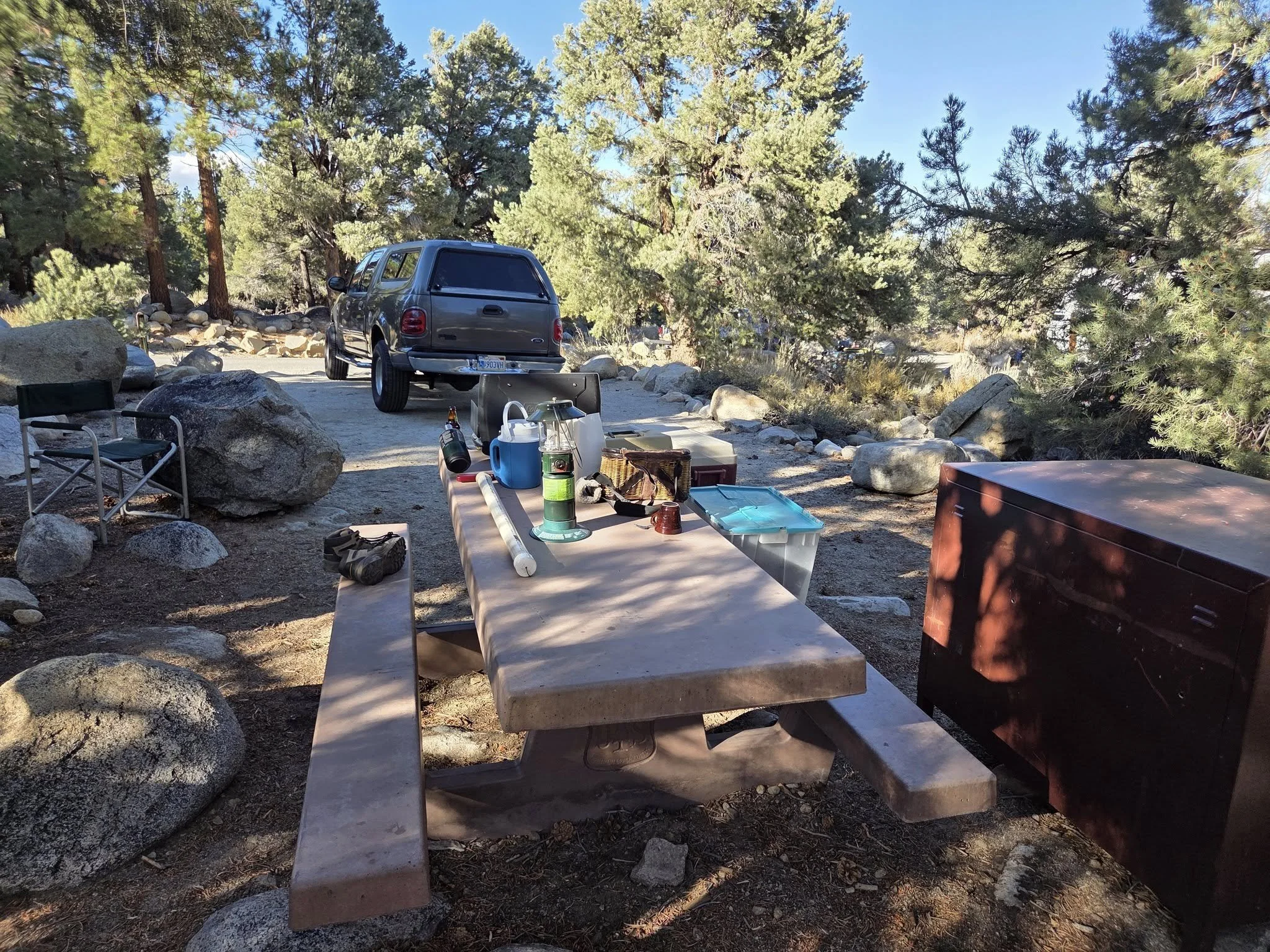
A fine campsite, but…
Last week’s post focused on October’s Sierra trip; a lesson learned on distinguishing between good and bad, using the analogy of eating trout. But it also taught a lesson about paradoxes, two truths that at least seem to oppose one another—the concept of balance. Another metaphor, this one on choosing a campsite.
A good campsite
needs sun
to warm the chilly fall days
a good campsite
needs shade
to escape the sun unfiltered by much atmosphere up high
Both opposite
Both needed
Both true
I do love fine paradoxes
they complicate life
yet increase our aptitude
to appreciate complexity
to transcend our finite biases
to increase our humility
to magnify our joy
My favorite spot at French Camp sits close to the stream, at the bottom end of the campground and with few close by. But while pondering this poem-to-be, I found a site that may work better. Mine had the sun, but not much midday shade. This has a better balance. Of course, we’re not really talking about campsites, but paradoxes.
Jesus used paradoxes. A lot. Just some: Save your life to lose it (Matthew 10:39). Greatness comes by serving (Matthew 23:11). Jesus didn’t come to judge not, but did (John 12:47, 9:39). So why do I like them?
The mental gymnastics I go through in attempting to understand the contrast brings a needed humility. I easily identify with God’s words, “For my thoughts are not your thoughts, neither are your ways my ways” (Isaiah 55:8). How can a limited and finite being fully comprehend an unlimited and infinite one? Ponder that, doesn’t that distinction bring a holy hush to your soul? Accepting paradoxes, without robbing them of their grandeur by trying to explain them away, gives us the freedom to acknowledge that we have no need nor ability to know it all. That’s a relief, even to this guy often driven by curiosity
But the valid attempt to understand paradoxes also brings benefits. God placed curiosity into our nature, “He has planted eternity in the human heart, but even so, people cannot see the whole scope of God’s work from beginning to end” (Ecclesiastes 3:11 NLT). He gives us a sense of transcendence, an awareness that reality goes beyond what seems to be the limits of our world.
That awareness of our incompletion stretches us on to expand our thinking, perhaps because both God and we abhor a vacuum in our understanding. It forces us to continually grow, since we realize that assuming we’ve got it wired means we claim perfection.
Mystery attracts many of us, and it requires we deepen our study, that we examine the context of the sayings, that we learn the heart of God.
Paradoxes. A difficulty at times. But what a delight to explore them!
Kick Starting the Application
What paradox most intrigues you? How have you approached paradoxes in the past? Do you tend to ignore them, or to investigate them to gain more understanding? How might you change?