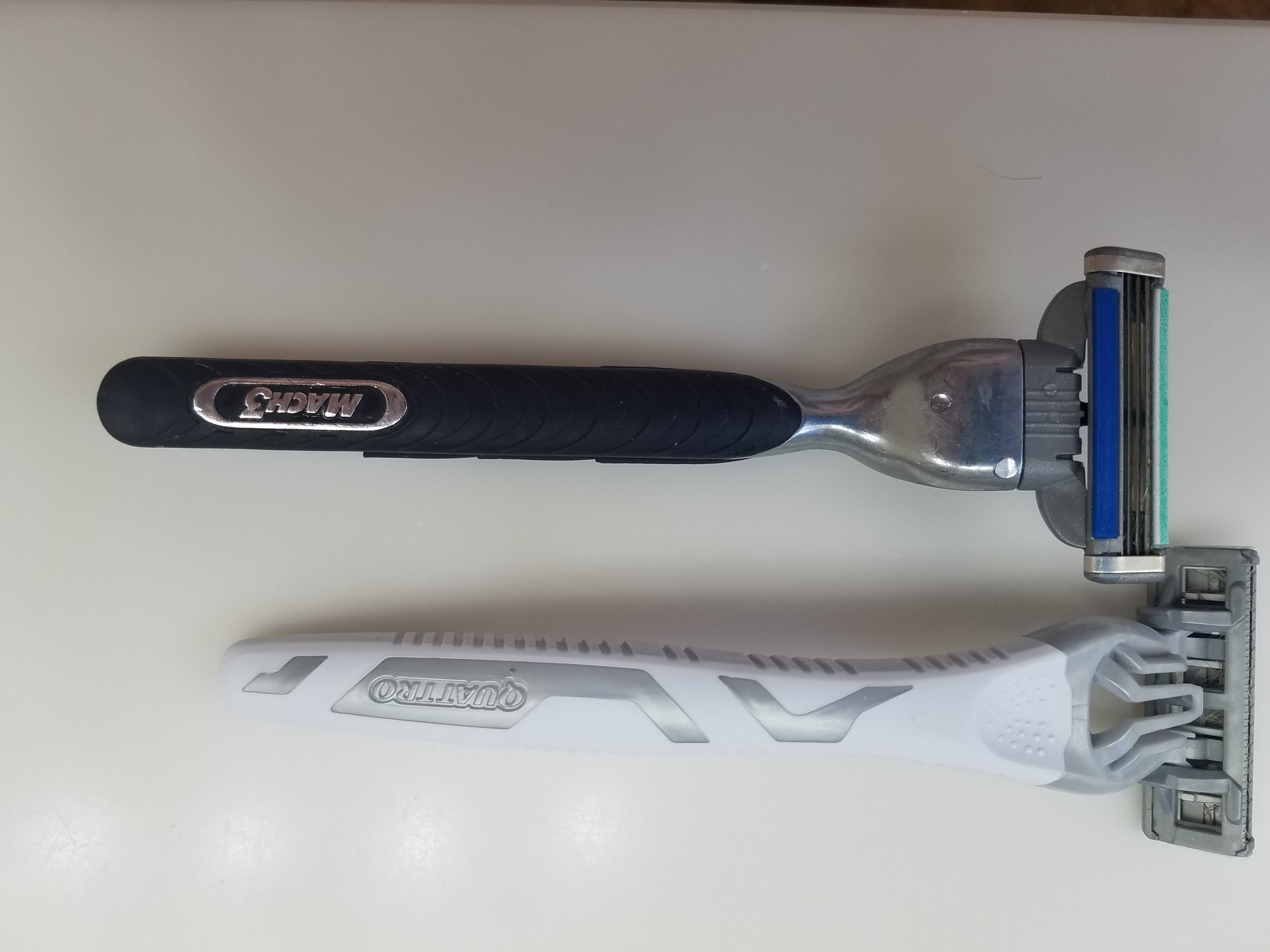
Most men shave most days, and it’s funny the bond you can build with an inanimate object. My face has developed a close friendship with a Gillette Mach 3 razor, ever since a friend, who worked for Gillette, gave me one 15 years ago. I now suspect he merely desired to induce me to buy Mach 3 blades. If so, he won—a lot went on my Costco credit card. That Gillette served me well and pleased me, until last July. On a motorcycle trip to Taos, my longtime friend and riding partner gave me a Schick Quattro, which amazed me at how smoothly it glided over my skin. It gave me a close shave with just one pass of the blade.
After three months the quality of shave tapered off, so I pulled out my trusty Mach 3, inserted a brand new blade and was quickly amazed how much better the…Schick was. Even after three months of usage, it outshaved the Mach 3. Significantly.
Now, I squeeze pennies at times, and possess no desire to waste my six remaining brand new Mach 3 blades. I will use them, each until the shave degrades, and then my new friend will be named Quattro.
Let’s apply this to the spiritual life and making changes. We often tend to build habits that become ruts: comfort and contentment can keep us in a comfort zone so deep we don’t consider options. But sometimes change benefits us. So, here come some tips on navigating spiritual changes.
1. Be open. Every so often, question each item in your life. Unless of course, you’re already perfect ;) . That’s biblical, Paul told us to test everything, in 1 Thessalonians 5:21. A friend may suggest a new approach, like Rich, or we read something, or the Spirit whispers, or we feel a vague discontent.
2. How important is it? A lot of changes are easy to make and bear minimal spiritual consequences, others need careful evaluation. The razor switch? Nice but minimal. Asking a person to marry you? Life-changing. Revising a long held theological position? Critical. Take more time and analyze these more.
3. Why switch? Or, be as careful about the reasons as the actual issue. Does it match biblical teachings? What roles do emotion and logic play? I know I’ve had to adapt quite a few theological beliefs as I learned more of what the Bible taught.
4. Give it a shot. Some changes seem good, they pass all the tests, but in practice they don’t bring a benefit. As long as changing back matches scripture, consider it a lesson learned.
Kick Starting the Application
What often prompts you to think of possible changes? Think of some changes you’ve made. Why did you make them—was it emotion or logic or God’s direction? How did it work out for you? Do you have some needed changes in mind right now? Try to work through those four tips, and let us know how it went!